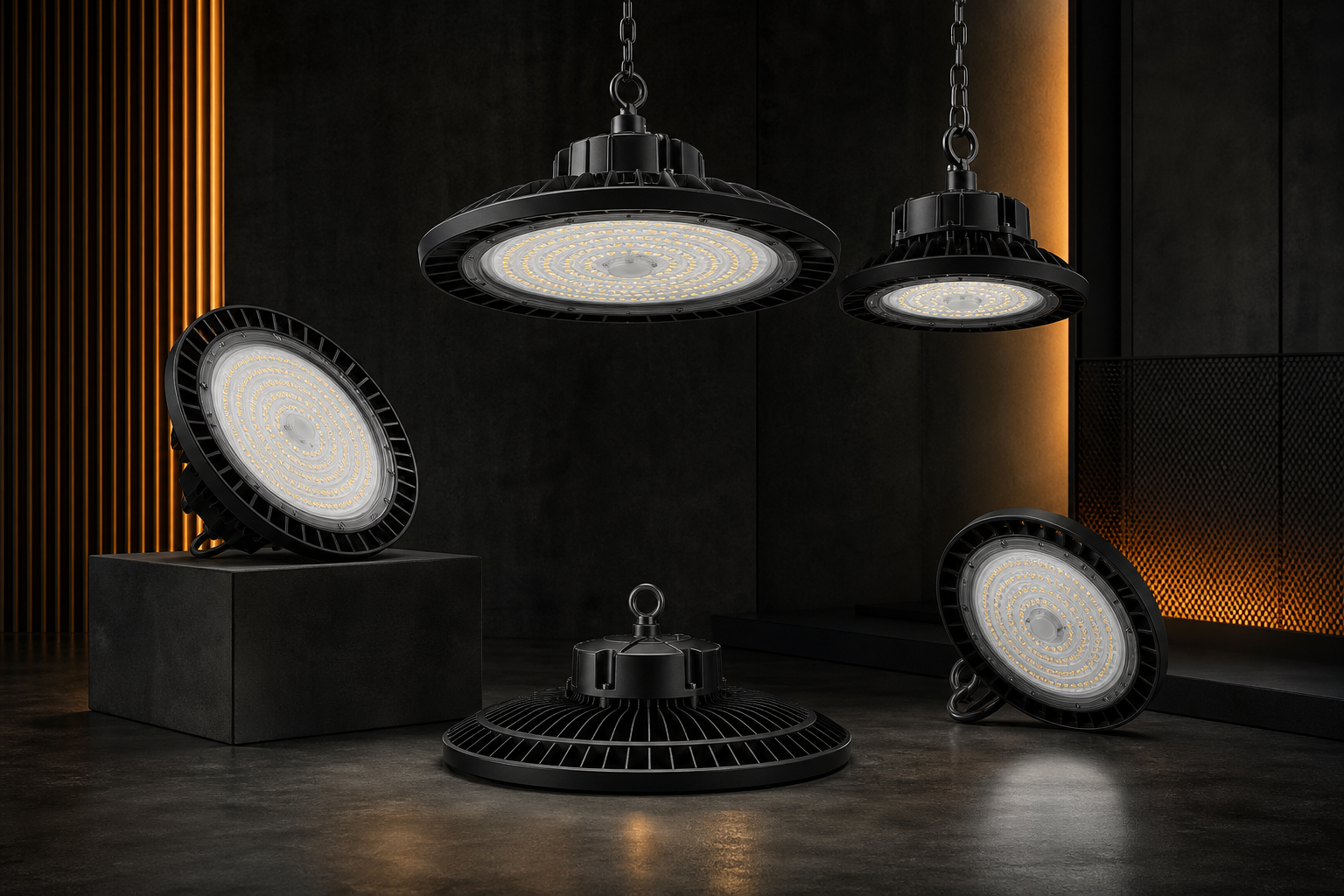
Decorative lighting is bought with the eyes; high bay is bought with a datasheet. A UFO or linear high bay fails two years in not because its housing looked wrong but because its thermal path was undersized, its driver was the cheapest available that week, or its photometry never matched the layout software. That is why a "Top 10 manufacturers" list of company names is nearly useless here: the same cluster can produce export-grade fixtures with LM-79 reports on one line and light-degrading commodity units on the next. What you need is not a name but a filter — ten checks that any quote-worthy supplier passes in writing.
AURELUX works the high bay category as a cluster sourcing partner: we do not own production lines, but we maintain a network of evaluated partner factories (40+ across five scene categories; illustrative count) and quote FOB Zhongshan or Shenzhen. Every commercial figure below is illustrative and confirmed at quotation.
Score every candidate against these, in writing, before a single unit price is compared:
| # | Check | What to request | Red flag |
|---|---|---|---|
| 1 | Thermal design | Heat-sink material and fin geometry; Tc point definition; junction temperature claim with math, not adjectives. | Same housing across all wattages with only the chip count changed. |
| 2 | LED package & binning | Chip brand and bin policy stated; SDCM window; documented L80/L90 expectations at real case temperature. | "High lumen LED" with no brand, bin or maintenance figure. |
| 3 | Driver policy | Named driver brand (Mean Well, Lifud, etc. as component suppliers) per wattage band, with dimming option table. | "Best driver available" — which usually means the cheapest that week. |
| 4 | Photometric files | IES/LDT files per SKU from LM-79-style measurement; Dialux-ready; uniformity data for your aisle geometry. | One generic IES file shared across the whole range. |
| 5 | Ingress & environment | IP rating with test report; ambient range; corrosion class for coastal or chemical plants. | IP65 claimed with no report; no ambient derating data. |
| 6 | Surge protection | kV/kA figures; 10 kV/10 kA is a working standard, higher for storm-exposed sites; optional SPD module. | "Protected" with no numbers — the most common 24-month failure. |
| 7 | Build & finish | Powder-coat thickness, salt-spray hours, cable gland quality, hook and safety-rope ratings. | Finish that scratches with a thumbnail on the sample unit. |
| 8 | Certification per market | CE / UKCA / SASO / SAA held via certified partner factories, verified by certificate number and official database link. | Certificate PDFs whose numbers do not resolve in the issuing database. |
| 9 | Warranty & spares | 2-5 years by product line with defined coverage; drivers and chips replaceable; 1-3% spares per program (illustrative). | "5 years" with no coverage document and no spares policy. |
| 10 | Factory QC system | ISO 9001-operating partner factories; burn-in sampling; integrating-sphere spot checks; AQL-based pre-shipment inspection. | QC described as "we check every light by eye". |
Industrial LED fixtures concentrate in the Pearl River Delta electronics belt — Shenzhen, Dongguan and Foshan — where driver supply chains, aluminum die-casting and SMT capacity sit within an hour of each other, with further pockets around Yangzhou and Jiangsu for linear industrial lines. The Guzhen cluster in Zhongshan, famous for decorative lighting, is less central here, though its export machinery (180+ destination countries, market-procurement channel 1039 for compliant small orders) is often the consolidation point when a project mixes industrial and decorative lines.
The practical routing: industrial fixtures buy best where their components are made; mixed containers buy best where the export channel is mature. A sourcing partner routes each line accordingly and consolidates at one port.
| Archetype | Profile | Best for | Watch for |
|---|---|---|---|
| UFO die-cast specialist | Own die-casting and finishing; tight thermal iteration per wattage; strong on retrofit replacements. | Warehouse and factory UFO programs, 100-240 W mainstream bands. | Weak on optics beyond standard 60/90/120 degree reflectors. |
| Linear high bay house | Extrusion-based linear fixtures; strong for aisle-specific optics and continuous runs. | Storage aisles, logistics halls, cold storage with sealed versions. | UFO range thin; verify both lines against the same checks. |
| Driver-integrator quality house | Builds around named-brand drivers with documented derating; pricier, specification-driven sales. | Tender-grade projects where failure cost exceeds unit cost. | Longer lead time; confirm 25-40 days after deposit (illustrative). |
| Commodity volume line | Lowest unit cost, catalogue photometry, minimal documentation. | Price-tender projects where documentation is not scored. | Lifetime claims without maintenance data; warranty paperwork thin. |
Quote at least one quality house against one volume line so your project's real requirement — documented reliability or lowest capex — becomes an explicit choice rather than an accident.
Working terms in this category are stable and worth standardizing: samples in 7-14 days courier-tracked; trial orders from 100-200 pcs; bulk production 25-40 days after deposit; T/T 30% deposit + 70% against B/L copy, L/C at sight for large orders; quotations valid 30 days; FOB Shenzhen or Zhongshan (all illustrative). Suppliers who resist writing these down are telling you how the dispute will go later. Require a pre-shipment inspection with AQL sampling and burn-in checks on a defined percentage of the batch, and a pack list that matches IES file versions so the photometry you laid out is the photometry that ships.
For the fixture-level physics behind checks 4 and 6, see our guide to LED high bay lighting and the layout math in the high bay spacing guide; the retrofit decision logic lives on our warehouse lighting solution page.
Between the ten checks and the purchase order sits a document-reading skill that separates buyers who get the fixture they laid out from buyers who get a fixture with the same catalog number. Start with the photometry: a real IES or LDT file carries the luminaire's own measured distribution, and the quick sanity check is comparing its lumen total and wattage against the quotation — mismatches mean the file belongs to another version of the product. Move to the thermal evidence: a credible datasheet names a Tc point (the temperature-measurement spot on the housing) and states the ambient temperature at which the claimed lifetime applies; a file silent on ambient is quoting laboratory numbers your ceiling will never see. Check the driver table line by line: input voltage range, output current, dimming protocol and surge rating should appear as specifications, not adjectives. And read the warranty document itself, not the number — coverage, exclusions, claims evidence and freight responsibility, as detailed in our warranty guide.
Then close the loop with the layout. Run the supplier's IES files through your own Dialux model of the hall before the trial order, and compare delivered lux against the quotation's promises. A factory confident in its photometry welcomes this; the exercise regularly reveals that a "150 lm/W" fixture delivers less working light than a competitor's honestly-quoted 130 — the difference between catalog luminous flux and delivered illuminance on the rack. For the layout method itself, the high bay spacing guide walks spacing, mounting height and uniformity step by step, and the energy math that anchors most retrofit decisions is covered in our factory retrofit payback analysis.
The complete buyer's guide: mounting heights, lumen packages and selection basics.
Which fixture geometry fits which hall — and which you should put on the quote sheet.
How LED lifetime ratings work and how to read them against a datasheet claim.
How professional buyers work the lighting capital — districts, audits and export routes.
Send the hall dimensions or the tender file — photometric files, driver options and FOB quotation within 24 hours.