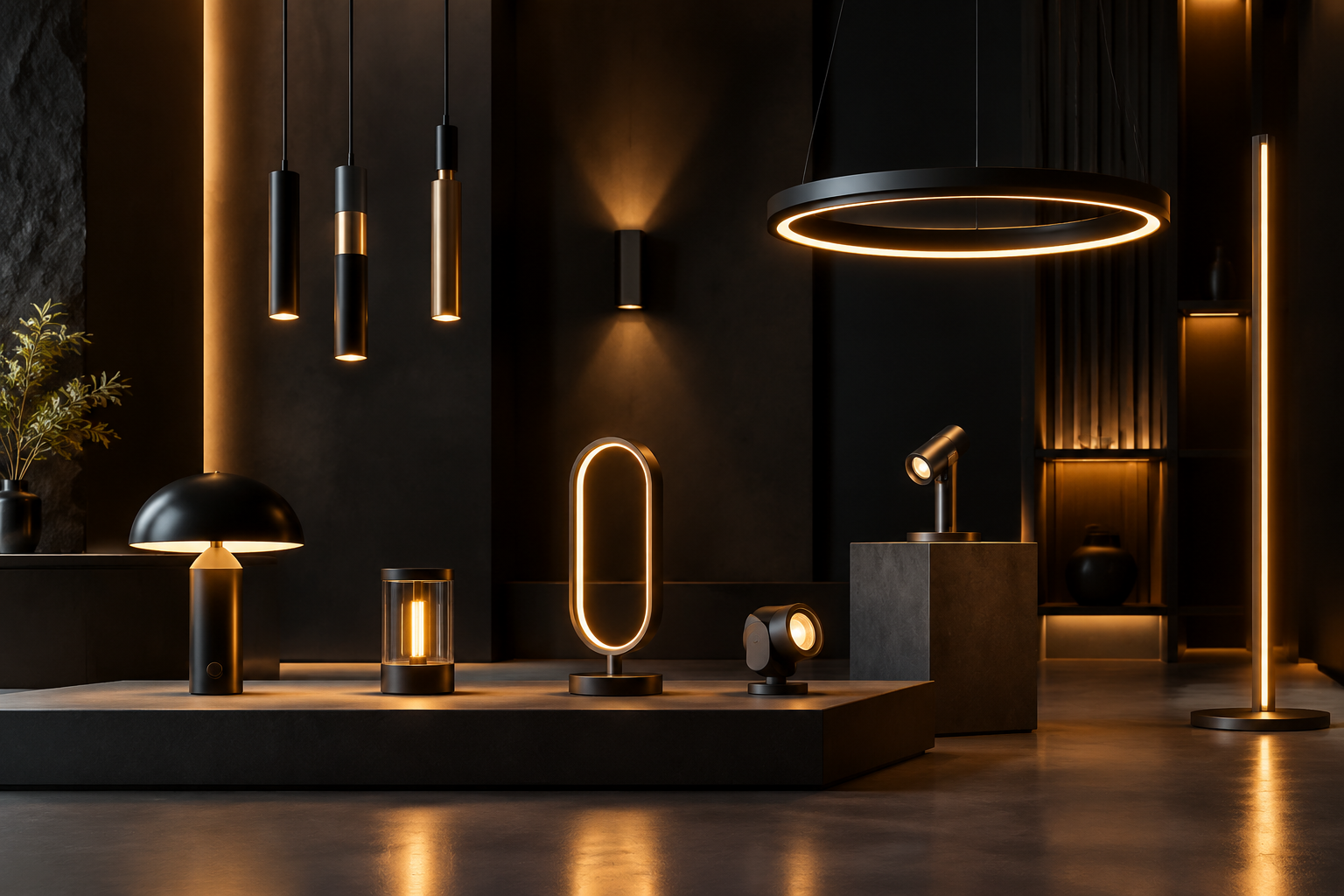
Trend lists fail distributors when they describe magazine aesthetics instead of purchase orders. The themes below are read from three demand engines rather than from design media: regulation (EU energy and buildings rules pushing controls into every tender), hospitality and contractor programs (the Middle East and Europe project pipeline that buys in container quantities), and the decorative mood cycle (the material and finish shifts that move showroom sell-through). AURELUX reads these from its position as a cluster sourcing partner coordinating decorative and technical lines across the Guzhen cluster and the wider Pearl River Delta; every stocking note is a working suggestion, not a guarantee.
| # | Theme | Category | Why now | Stocking note |
|---|---|---|---|---|
| 1 | Controls-ready everything | Downlights, panels, track | EU buildings rules make sensing and dimming a tender line, not an upgrade. | Stock DALI-2 and 0-10V driver versions beside fixed-output basics. |
| 2 | Warm dim & hospitality whites | Downlights, pendants | Hotels standardize on 2700K-2200K warm-dim scenes; diners feel it before they see it. | One warm-dim SKU family per category beats five disconnected ones. |
| 3 | Magnetic track systems | Retail, office | 48V platforms consolidate spot, grid, pendant and linear on one track — designers specify the system, not fixtures. | Carry the track, adapters and a full module family, or carry none of it. |
| 4 | High-CRI retail light | Track heads, linear | Retailers chase color truth (CRI 90+, R9 data) as e-commerce forces in-store quality up. | Lock bin policy with your supplier; inconsistency kills repeat sales. |
| 5 | Solar 2.0: LiFePO4 + MPPT + motion | Solar street & garden | Battery chemistry and controller upgrades finally deliver promised autonomy; off-grid and blackout-prone markets buy. | Spec by component and autonomy math, never by label wattage. |
| 6 | Alabaster & stone series | Decorative | The warm-minimalist interior cycle favors glowing stone; hospitality lobbies lead, retail follows. | Approve material as a range; stock forms, quote shades per project. |
| 7 | Wabi-sabi materials | Decorative | Raw ceramic, paper, rattan and hand-blown glass carry the handmade narrative buyers pay for. | Position as curated collections with honest variance notes. |
| 8 | Dark-sky compliant outdoor | Street, flood, area | Light-pollution rules and resort aesthetics converge on shielded, warm, low-glare outdoor lines. | Add shielded optics and 2700K options to the outdoor wall plan. |
| 9 | Emergency & compliance packs | Downlights, battens, exits | Inspection regimes tighten; retrofit programs bundle emergency inverters with replacements. | Stock the inverter versions of your bestselling downlights. |
| 10 | Smart-ready retrofit | Bulbs, ceiling, strips | Matter-era interoperability lowers consumer confusion; retrofit lines sell through retail channels. | Prioritize protocol-stable lines with long firmware support promises. |
Stocking notes are working suggestions from cluster order patterns; validate depth against your own sell-through each quarter.
Every theme that rises displaces something. Fixed-output, non-dimmable panel and downlight basics will keep volume but lose margin as controls-ready versions take the specification tier — hold the basics as a price anchor, not as the story. Cool-white-only interior lines (5000K and above in hospitality-facing categories) shrink as the warm cycle deepens. Pure-halogen-look decorative lines without LED modules are end-of-life in most EU-facing channels. And cheap fixed solar units with unlabeled battery chemistry are a warranty liability disguised as a price win — the category's buyers have learned to ask.
Middle East programs concentrate on hospitality and municipal scale: warm-dim guestroom layers, statement chandeliers and stone series for lobbies, solar street infrastructure for expansion districts, and SASO-ready documentation as the entry ticket. European channels concentrate on regulation-driven replacement: controls-ready and flicker-documented product, EPREL-registered light sources, emergency versions, dark-sky outdoor and the decorative stone-and-ceramic wave in premium retail. The same container can serve both, which is precisely the argument for a cluster partner who routes lines to the right factories and consolidates one shipment — see the decorative and commercial catalogs for how the lines split.
The cluster's commercial norms exist for exactly this: sample 1-5 pcs to validate, then a 100-200 pc trial order to test sell-through before bulk (illustrative terms; bulk from 500 pcs). Treat trend SKUs as experiments with defined success metrics — sell-through rate, margin, return rate — and a kill date. The two decorative trends deserve one extra caution: handmade and natural-material lines (wabi-sabi ceramics, alabaster) require variance language in your catalog and display, or your returns desk becomes the trend's biggest critic. Our pieces on the wabi-sabi trend and alabaster sourcing cover the variance rules.
Stocking a trend is half the work; presenting it decides whether the container turns into revenue. The decorative themes reward scene merchandising — alabaster and wabi-sabi lines sell as lit vignettes, not shelf SKUs, so budget display stock and photograph your own installations, because the after-dark glow is the product's advertisement. Controls-ready commercial lines sell through documentation merchandising: a one-page spec sheet per SKU with DALI-2 evidence, flicker figures and energy data converts specification buyers that a brochure never will. Solar and outdoor themes sell through proof merchandising — autonomy math for the customer's latitude, component datasheets, and install photos — because the category's credibility problem is solved with paper, not price. Match the sales collateral to the theme's buying logic and the same inventory performs differently.
Two regional notes complete the plan. In Gulf markets, the 2026 conversation concentrates on hospitality programs and solar infrastructure: warm-dim guestroom layers, statement stone chandeliers, SASO-ready documentation, and LiFePO4-class solar with real autonomy numbers for municipal buyers. In European channels, regulation writes the story: controls-ready and EPREL-documented product, emergency versions, dark-sky outdoor, and the stone-and-ceramic decorative wave in premium retail — with the EPBD-driven controls demand detailed in our EPBD guide. The same cluster supply serves both; the difference is which trend wears the front of the catalog. AURELUX organizes the supply side across these lines as a cluster sourcing partner; the stocking decisions stay with the distributor who knows their floor.
Trend lists are inputs, not instructions — the same ten themes weight differently in different channels. A wholesale house serving electrical distributors should weight themes 1, 3, 9 and 10, where specification and replacement volume concentrate. A showroom or design channel should lead with 2, 6 and 7, where margin lives in the fixture and the story. A project or contracting channel reads 1, 5, 8 and 9 as its core, because tenders write the quantities. And any channel serving both Gulf and European customers runs a dual-front catalog by necessity, as described above. The disciplined method: score each theme 1-5 against your last twelve months of order data, fund the top four with pilot orders, and review quarterly — the list is a year old before the container lands, and the quarterly review is what keeps stocking decisions younger than the trends they follow.
Materials, finishes and bestselling forms — and how to sell handmade variance honestly.
Why EU projects now ask for controls — the regulation behind theme one.
The controls protocol comparison your 2026 shelf needs to get right.
How professional buyers work the lighting capital — districts, audits and export routes.
Tell us your channel and region — a trend-mapped product schedule with 100-200 pc trial terms within 24 hours.