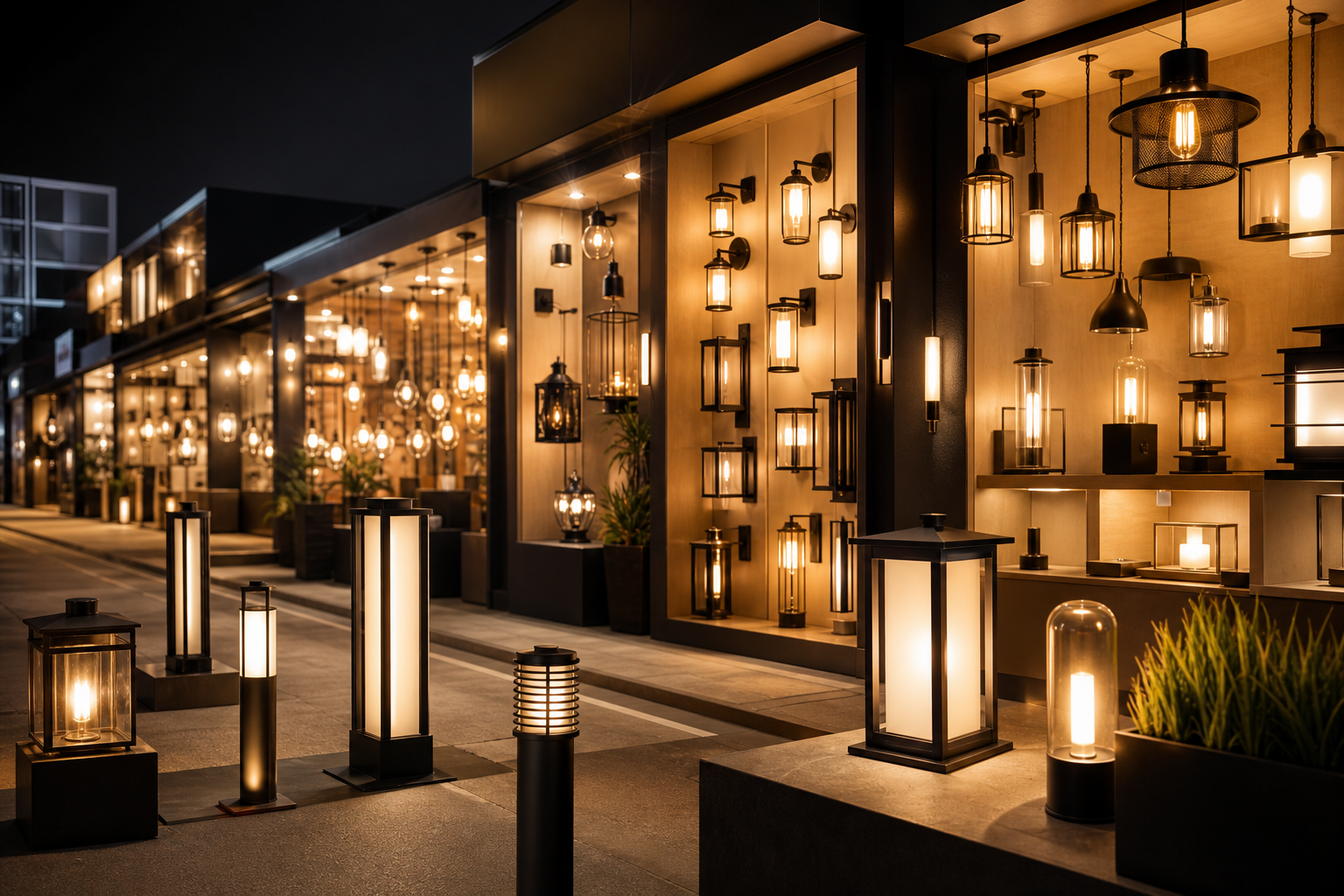
One town supplies most of the world's decorative lighting. Here is how the market is organized, how to spend three productive days in it, and which buying rituals to learn before you arrive.
2026-09-10 · 8 min read · Sourcing guide
Guzhen, a town in Zhongshan, Guangdong, is the center of gravity for decorative lighting on earth — and the numbers behind that claim are citable rather than promotional. The cluster reports an annual output value above CNY 100 billion; it holds roughly 70% of China's decorative lighting market (a figure that applies to decorative scope only — never generalize it to industrial or outdoor categories); its products reach 180+ countries and regions; and the Guzhen Lighting Fair hosts 350,000+ buyers annually across both seasons, from more than 130 countries (Zhongshan municipal and fair-authority sources, 2024-25). The cluster's defining structural fact is full-chain local supply — components from a single screw to the finished lamp are all made locally — which is why a custom chandelier can iterate from sketch to revised sample in days rather than weeks.
AURELUX is based in this cluster as a sourcing partner, not a factory: the role exists because the market's scale is also its difficulty. Thousands of workshops, marts and storefronts overlap; quality and documentation discipline vary stall by stall; and the right counterpart for a hotel program is rarely the one with the best-lit showroom.
First-time buyers expect one "market". Guzhen is better understood as four layers:
The fair and marts are where relationships start; the production districts are where your order actually lives. Budget your trip accordingly.
| Day | Focus | What to accomplish | Leave with |
|---|---|---|---|
| Day 1 | Range discovery | Walk two major marts plus the flagship street; photograph lines that fit your catalog; collect price-grounding quotes without negotiating. | A shortlist of 8-12 candidate suppliers by category. |
| Day 2 | Shortlist meetings | Meet the top 4-6 candidates with your item list; discuss MOQ, sampling and certification per destination; see workshops where access allows. | Agreed sample specs and sample timelines (7-14 days standard, 14-21 custom; illustrative). |
| Day 3 | Verification & terms | Verify business licenses, ask for certificate numbers, agree commercial terms in writing, plan consolidation and inspection. | A written RFQ pack per candidate and a follow-up calendar. |
During fair weeks, compress discovery into Day 1-2 at the fairgrounds and protect Day 3 for terms — the fair is the worst place to negotiate and the best place to shortlist.
Samples are the language. Nobody expects you to buy from a catalog; every serious conversation ends in a sample order. Standard-construction samples typically ship in 7-14 days courier-tracked, and qualified distributors can often arrange free samples with courier collected (illustrative cluster norms). Trial lots are normal. The working rhythm is sample, then a 100-200 pc trial order, then bulk — and the cluster's market-procurement trade pilot (customs code 1039) exists precisely so small orders can export compliantly without general-trade overhead. Non-standard is the default. Decorative lines quote per project; fixed MOQ thinking belongs to commodity categories. Everything is negotiable except silence: terms that never reach writing — freight responsibility, spares, packing specs — will be reinterpreted at loading time.
You can work Guzhen alone — thousands of buyers do. A partner changes the economics when your program is mixed or certification-heavy: one team pre-vets the workshops, runs pre-shipment inspection to a single AQL standard, verifies certificate numbers against official databases per order, and consolidates your decorative and technical lines into one mixed-SKU container with FOB Zhongshan or Shenzhen (T/T 30% deposit + 70% against B/L copy is the common structure; illustrative). That is the service AURELUX provides from inside the cluster. Pair this guide with our long-form Guzhen sourcing guide, browse what the cluster produces in the decorative lighting catalog, and see the program level on our hotel lighting solution page.
The market rewards presence, but programs are won in the weeks after the flight home. Convert Day 3's written RFQ pack into a comparison sheet within the week — suppliers who received identical specifications return comparable answers, and the 30-day quote validity (the cluster norm; illustrative) sets your decision calendar. Run samples in parallel rather than in sequence: two or three candidates sampling simultaneously costs little extra courier money and halves the time to a decision. Judge samples against the written schedule, not against each other's charm — dimensions, materials, grades, driver specs, packing — and photograph everything on arrival, because the sample that reaches you is the evidence in any later disagreement.
Remote follow-up also has its rituals. Video calls at agreed times beat message threads for technical questions; a standing request for production photos at defined milestones replaces the factory visit you cannot make; and the trial order — 100-200 pcs through the cluster's compliant small-order channel — is itself the best remote audit, complete with third-party pre-shipment inspection before the balance payment. The buyers who fail remotely are the ones who treat the trip as the project; the ones who succeed treat it as the sourcing sprint that starts a managed pipeline. The full verification discipline behind that pipeline is in our supplier verification guide, and the terms layer sits on our wholesale terms page.
Which sourcing system fits which product line — and how to route a mixed order.
License checks, audits, certificate databases and payment structures before you wire.
The question list that turns a showroom visit into a sourcing decision.
How professional buyers work the lighting capital — districts, audits and export routes.
We pre-vet the workshops, set the meetings and verify the paperwork — start with an item list and get a routing plan within 24 hours.