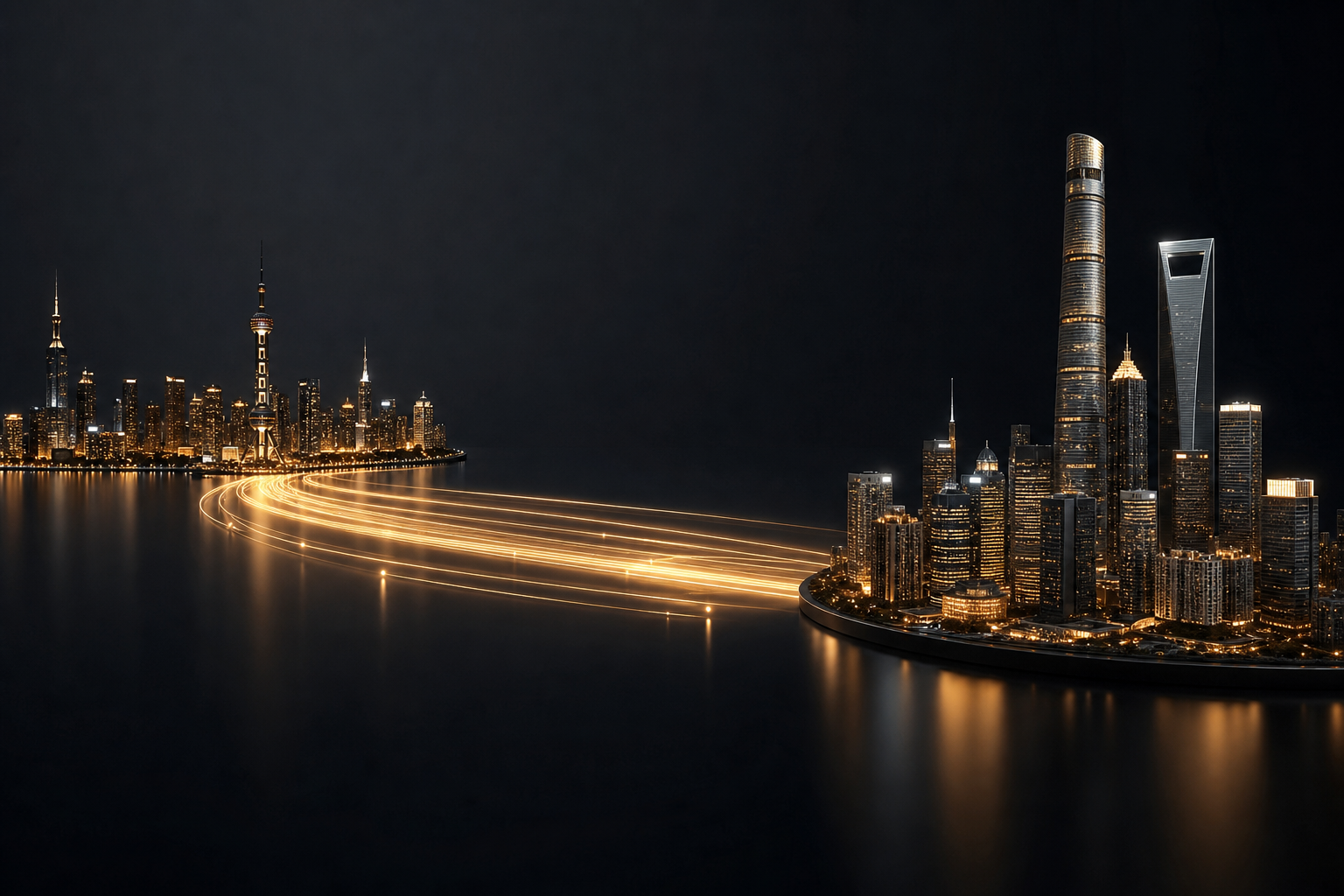
Two sourcing systems an hour apart: the decorative full-chain cluster of Guzhen and the electronics depth of Shenzhen. Here is how to route each product line — and how to route a mixed container.
2026-09-10 · 8 min read · Sourcing guide
The question "Guzhen or Shenzhen" sounds like a choice between cities, but it is really a choice between two manufacturing systems that share a supply chain. Guzhen, the town in Zhongshan known as China's lighting capital, is a full-chain decorative lighting cluster: thousands of specialized workshops and marts where the frame shop, the crystal house, the plating line and the export agent all sit within a few kilometers — an ecosystem reporting an annual output value above CNY 100 billion, roughly 70% of China's decorative lighting market (decorative scope only), and exports to 180+ countries and regions (Zhongshan municipal sources, 2024-25). Shenzhen is an electronics manufacturing system that happens to make lighting: driver supply chains, SMT lines, smart modules, wireless ecosystems and the certification service industry that EU and North American-bound electronics demand.
AURELUX operates across both as a cluster sourcing partner — routing each product line to the system that makes it best, then consolidating at one port. This guide is the routing logic we apply, with every commercial figure marked illustrative.
| Product line | Better base | Why |
|---|---|---|
| Chandeliers, pendants, wall lamps | Guzhen | Material-specialist workshops, project custom culture, accessible MOQs. |
| Stone series (alabaster, travertine) | Guzhen | Stone-shade studios and finishing crafts concentrated in the cluster. |
| Downlights, panels, battens (volume) | Either | Both systems produce well; decide on driver spec and certification depth. |
| Track & magnetic systems | Shenzhen-leaning | Optics platforms, control modules and driver ecosystems sit there. |
| UFO / linear high bays | Shenzhen / PRD electronics belt | Thermal engineering, driver pairing and photometric documentation culture. |
| Solar street lights | Both zones assemble | Panels, batteries and housings move freely; verify components, not the postcode. |
| Smart / sensor lighting | Shenzhen | Wireless modules, Matter-ready stacks and sensor supply chains are native. |
| Mixed program (decorative + technical) | Consolidate via the cluster | One QC gate and one container from Zhongshan with FOB Zhongshan or Shenzhen. |
Routing is a working generalization, not a rule — strong factories exist outside their zone's specialty. Use it to prioritize the search, not to end it.
Beyond product fit, the two systems behave differently in process. In Guzhen you negotiate with workshops and marts: MOQs are flexible, customization is welcome, but documentation discipline varies — so your verification and QC layer matters more. In Shenzhen you deal with organized manufacturers: documentation, test reports and ISO-style processes are stronger, but MOQs are firmer and customization slower. Neither is better; they are different risk profiles. Guzhen trades process discipline for flexibility, Shenzhen trades flexibility for process.
Freight and payment are broadly common ground: FOB Zhongshan or FOB Shenzhen by origin, T/T 30% deposit + 70% against B/L copy, L/C at sight for bulk, quotations valid 30 days, bulk lead time 25-40 days after deposit (all illustrative). What differs is where the 25-40 days is spent — in Guzhen it is finishing queues and assembly; in Shenzhen it is driver procurement and burn-in.
A realistic hotel program illustrates the method. The lobby chandelier and guestroom pendants source in Guzhen — material specialists, custom sizing, sample round in 7-14 days for standard constructions. The corridor downlights and bathroom-rated fixtures source wherever the driver spec and IP documentation are strongest. If the project includes a smart floor with sensors and scene control, those modules come from the electronics belt. One partner consolidates all lines, runs pre-shipment inspection against a single AQL standard, and loads a mixed-SKU container — FOB Zhongshan when the weight is decorative, FOB Shenzhen when electronics dominate.
That is precisely the work AURELUX does as a cluster sourcing partner: the decorative catalog routes to Guzhen workshops, the commercial and industrial lines route by driver and photometric depth, and smart lighting programs draw on the electronics belt — one accountable channel, one container. For the on-the-ground version of this guide, see our Guzhen field guide.
The two systems also differ in how compliance work gets done, and that difference belongs in the routing decision. The electronics belt's service industry — test labs, certification consultancies, driver makers with their own certification departments — means destination compliance is close to the production line: CE, UKCA and SASO evidence for a Shenzhen-built driver or high bay is typically a request to an in-house department. The decorative cluster organizes compliance through its export infrastructure instead: certifications for chandeliers and decorative lines are held by certified partner factories and coordinated per order, with certificate numbers and official database links as the verification currency. Neither route is slower in experienced hands; they simply put the paperwork in different buildings.
For the buyer, two habits reconcile the difference. First, ask the certification question at routing time, not after samples: a stone-series program heading to Saudi Arabia needs its SABER path planned by whoever organizes the workshops, and a smart-floor program heading to the EU needs its radio modules' RED evidence confirmed before the container is mixed. Second, standardize the document pack across zones — the same checklist for test reports, declarations and certificate numbers regardless of which city built the fixture — so your verification layer, whether in-house or via a cluster partner, has one shape. The destination-by-destination map lives on our certifications page, and the verification mechanics are detailed in our supplier verification guide.
Districts, the Lighting Fair, sample rituals and a three-day buying plan.
Cost and lead time compared — the trade that separates Guzhen and Shenzhen logic.
Mean Well, Lifud and others — the component choice that routes lines between the zones.
How professional buyers work the lighting capital — districts, audits and export routes.
Send your item list — we route each line to the right zone, consolidate the container and quote FOB within 24 hours.