2026-09-24 · 6 min read · Comparison
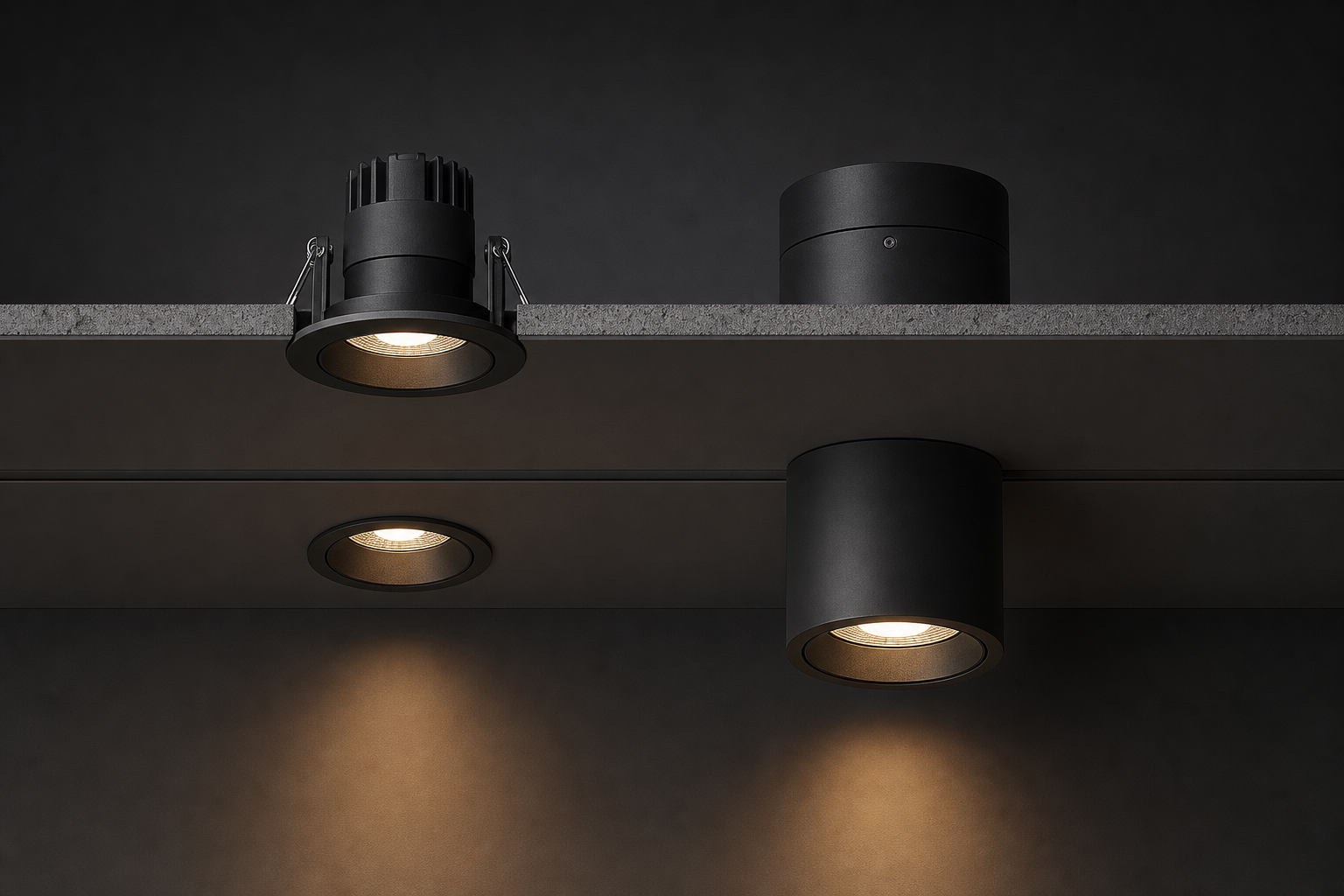
Flush mounts and semi flushes are the two fixtures most often installed in a house and the least often chosen deliberately. Both hang from a standard ceiling box, both close with a lens or shade, and both exist to put general light in a room without a pendant's drama. The difference is one measurement: a flush mount sits against the ceiling with its lens in contact, while a semi flush drops 10-30 cm on a short stem (illustrative), leaving an open gap between shade and ceiling. That gap turns out to change almost everything about the light — and the room each fixture serves best.
What each type actually is
A flush mount seals directly to the ceiling: a canopy over the box, a shallow housing, and a diffuser — acrylic, glass or fabric-look — at the ceiling plane. Total protrusion is minimal, commonly under 5 cm for low-profile LED discs, which is exactly why it owns tight spaces. A semi flush suspends the same idea on a stem or short chain, letting the shade hang below the ceiling with air on all sides. Shapes open up accordingly: drums, schoolhouse globes, lanterns and shallow domes that would be impossible flush. Both mount on a standard box, and both are the default answer wherever a ceiling box exists but the room does not want — or cannot fit — a pendant.
The light distribution difference
Physics does the dividing. A flush mount throws light down and sideways through its lens, lighting the floor plane efficiently while the ceiling above stays relatively dark. A semi flush emits downward too, but the open top gap bounces a meaningful share of its light off the ceiling, washing the plane above the room with reflected fill. The result reads as the softest ambient light in the house: fewer hard shadows, a lifted ceiling, a room that feels evenly lit rather than pooled. The effect depends on the ceiling itself — a white, matte ceiling reflects generously; a dark or glossy one mutes it — which is one more reason semi flushes belong in rooms with height and light-colored ceilings rather than tight, low ones.
Comparison at a glance
| Dimension | Flush mount | Semi flush |
|---|---|---|
| Ceiling fit | Contact with ceiling; often under 5 cm protrusion | Needs a 10-30 cm drop to breathe |
| Best ceiling height | Under ~2.4-2.6 m (8-8.5 ft) | 2.6 m (8.5 ft) and up |
| Light character | Direct downlight + sideways lens glow | Direct + ceiling bounce; softest ambient |
| Style range | Utility domes to low-profile discs | Drums, schoolhouse globes, lanterns, fabric shades |
| Best rooms | Hallways, closets, laundry, baths, basements | Bedrooms, living rooms, dining rooms, entries |
| Cleaning | Flat lens, one wipe | Open gap collects dust over time |
| Relative cost | Entry-level to mid | Mid, scales with shade size (illustrative) |
Illustrative trade conventions; individual products blur the edges — some low-profile semis hang barely 8 cm, some deep flush discs protrude more than shallow drums.
Choosing by ceiling height and room
Height is the first filter. Under about 2.4 m (8 ft), flush is the answer — anything hanging into that volume crowds heads and sightlines. Between 2.4 and 2.6 m either works, with the semi flush's drop checking against tallest-household-member headroom. At 2.6 m and above, the semi flush starts to earn its keep: it fills vertical volume a flush disc leaves empty and its ceiling bounce finally has the height to work. Room assignments follow: hallways, closets, pantries, laundries, bathrooms and basements default to flush; bedrooms, living rooms, dining rooms and entries default to semi flush where height allows. Sloped ceilings complicate both — flush housings gap badly on a pitch, so sloped-ceiling adapters or a small pendant take over.
Style: the semi flush advantage
Because the shade is free of the ceiling, the semi flush inherits most of the pendant's design vocabulary at pendant-unfriendly heights: fabric drums that soften bedrooms, schoolhouse glass that suits craftsman and cottage plans, lanterns for entries, and stone-look domes in the current alabaster trend. The flush mount counters with invisibility — the low-profile LED disc is the minimalist's answer, present only as light. Between the poles sit flush drum shades and schoolhouse-flush hybrids that keep some character at minimal protrusion. The full range of both, from discs to shade pieces, sits in our flush mount ceiling lights collection, with the pendant end of the family in chandeliers and pendants.
Installation and LED notes
Both mount on a standard ceiling box; the checks that matter are weight for glass drums (anything heavy wants a rated box), and the LED specification. Integrated LED versions dominate now — slimmer, sealed and efficient — and buying them well is a separate skill: output, color temperature, dimming behavior and driver serviceability, all covered step by step in our LED flush mount buying guide. For the recessed alternative that leaves the ceiling entirely clean, the trade-offs are compared in recessed vs surface mounted lighting. And when ceiling height plus room importance line up, skip both categories: a pendant delivers what neither can, which is why dining rooms and entries graduate to pendant lights the moment height allows.