2026-09-30 · 8 min read · Floor Lamps · Explainer
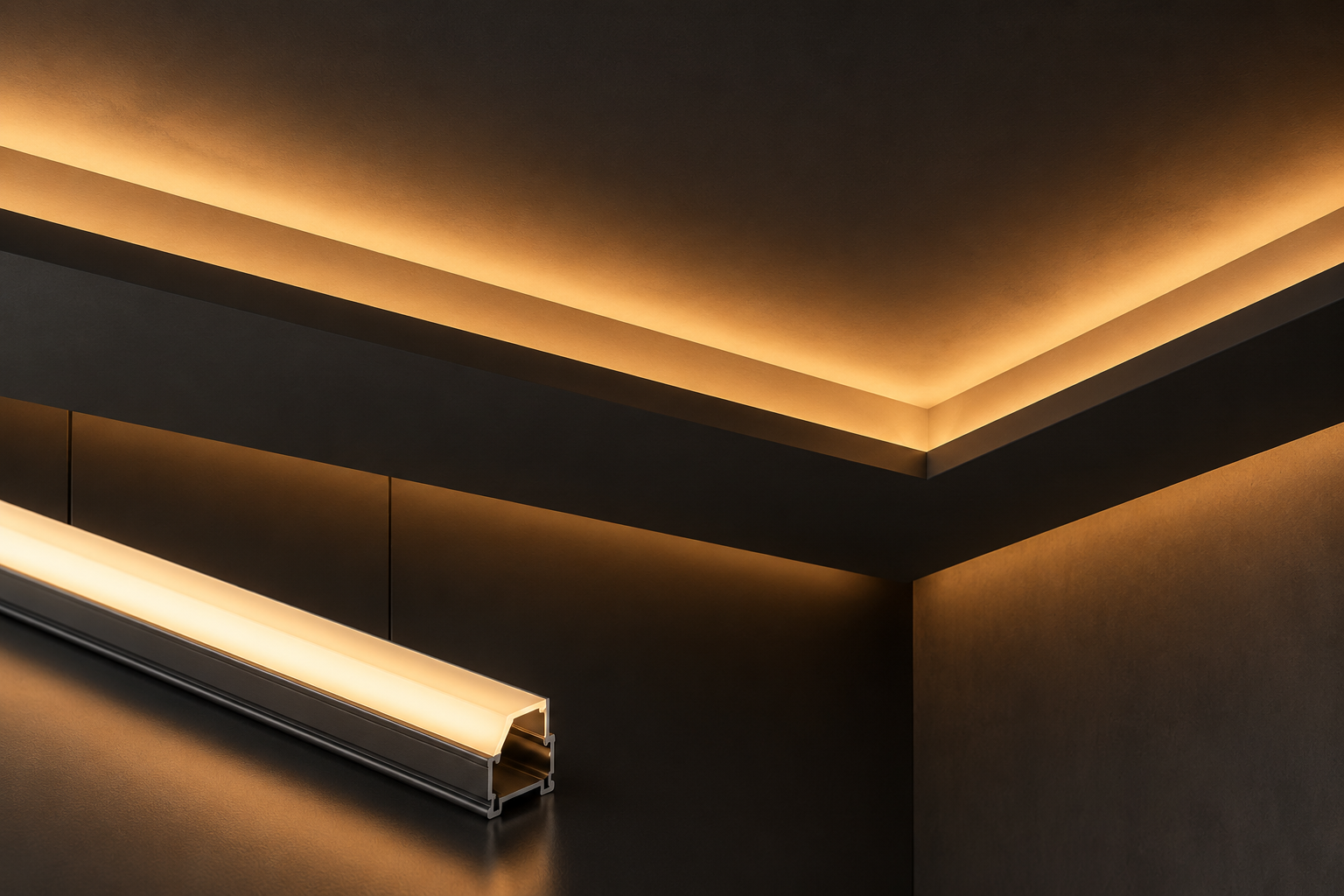
Among the floor lamp family, the torchiere is the only member whose light you are not supposed to see. Named after the upturned torch it resembles, a torchiere stands on a slim column, crowns itself with an upward-facing bowl or reflector, and throws its entire output at the ceiling — which bounces it back down as soft, shadowless ambient light. Nothing in the room is directly lit; the room is lit by its own surfaces. That indirect principle, the same one architecture borrows for coves and perimeters (see our cove lighting explainer), is why torchieres make dark rental rooms and ceiling-fixture-less apartments feel finished — and also why the same lamp can underwhelm in a room whose ceiling is the wrong colour or the wrong height. This explainer covers the physics, the placement rules those physics imply, and what two decades of LED retrofitting changed.
The uplight principle: how a torchiere works
A torchiere is a two-surface system: the lamp and the ceiling. The bowl-mounted source fires upward; the ceiling receives a broad wash of light and reflects it back into the room as diffuse illumination. Every photometric property of the result — softness, evenness, the absence of glare — comes from the fact that the light's arrival direction is spread across the entire ceiling plane rather than concentrated in one bright point. Shadows soften because light reaches surfaces from many directions; the source itself stays out of the eye line because you see only a glowing bowl edge, never the LED.
The corollary is that the ceiling is a component. Reflectance decides efficiency: a flat white ceiling returns most of the light it receives, while dark, textured or heavily beamed ceilings absorb it, so the same torchiere produces visibly different rooms. Height decides spread: at standard residential ceiling heights the bounce cone covers a wide, even pool, while very high ceilings dilute the same lumens into faintness. Even the ceiling's finish matters — glossy surfaces can bounce a visible hot spot back down. Buyers evaluating a torchiere are therefore evaluating their room as much as the product, which is the category's most common misunderstanding and the root of most disappointing reviews.
Where torchieres fit — and where they disappoint
The format earns its keep in specific situations. Living rooms and bedrooms without any ceiling fixture — the common condition of rentals, conversions and older homes — gain an ambient layer exactly where hardwiring is impossible; dark corners of otherwise well-lit rooms lift; and reading zones already served by task lamps get a soft background layer that makes the whole seating group usable in the evening. In hospitality and lounge contexts, torchieres appear where ceiling circuits are locked but atmosphere is not, a flexibility our hospitality lighting team uses in phased refurbishments. Because a torchiere lights generally rather than locally, one unit can carry a small room's entire evening lighting — something no directed lamp can claim.
The disappointments are equally predictable. A torchiere cannot read by: its light is ambient, and holding a book in a torchiere-lit room still wants a directed lamp beside the chair. Dark ceilings defeat it; a charcoal-painted ceiling can swallow a large share of the output (illustrative of reflectance physics, not a fixed figure). Very tall ceilings weaken it. And rooms that already have strong ambient lighting gain little from adding a second indirect source. The honest specification is: torchiere for the room's ambience, paired with a directed lamp for tasks — the over-the-sofa alternative and its trade-offs are compared in our arc floor lamp guide, and the three formats sit side by side in the table below.
LED retrofit and dimming compatibility
The torchiere's history is an LED retrofit story. Halogen torchieres of the 1990s threw brilliant upward light but ran hot — bowl temperatures made them a documented fire concern near curtains and ceilings, and their consumption was brutal for an always-on ambient lamp. Early CFL retrofits cooled and economized them at the cost of dimmability and instant start. The modern LED retrofit resolves both: an LED lamp in a standard socket runs cool, sips power, starts instantly and — the critical spec — dims if the fixture's dimmer and the lamp agree with each other.
That agreement is where retrofits succeed or fail. Traditional torchieres dimmed through a simple inline or foot-switch dimmer designed for incandescent loads; pair it with a non-dimmable LED and the result is flicker, dead zones at the bottom of the range or an audible whine. The practical checklist: choose lamps explicitly marked dimmable, confirm the fixture's stated dimmer type, and prefer fixtures whose manufacturers list compatibility with common LED lamp types. Fully integrated LED torchieres — the light engine built into the bowl — sidestep compatibility entirely and dim smoothly by design, at the cost of replacing the whole fixture when the engine eventually expires. Output expectations are usefully anchored by our Kelvin-lumen quick table: an ambient torchiere wants a generous lumen package precisely because much of it is absorbed en route, and warm colour — 2700K, with the 3000K trade-off in our comparison guide — is what makes bounced light feel like lamplight rather than office light.
What to check on the spec sheet
Between two torchieres that look alike, five lines separate them. Bowl geometry and depth: a deep bowl directs light tightly upward for a focused pool; a shallow or open bowl spreads wider but exposes more glare at eye level from across the room — check whether the design shields the source from a seated sight line. Socket type and maximum wattage (for retrofittable models): the maximum rating is a heat limit for the bowl, and it is also where LED retrofits flex, since a modern LED lamp reaches old incandescent outputs at a fraction of the wattage. Dimmer type: full-range rotary, step touch, or fixed — and stated LED compatibility. Base and column: a wide, weighted low base resists tips in households with children and pets; column joints should lock, not friction-fit, because a tall column works loose. Switch position: foot switches survive daily use; mid-column switches invite column wobble over the years.
For program buyers the list extends with commercial logic: lamping strategy (integrated versus retrofittable) decides the product's service life and its returns profile; finish families should follow the broader decorative lighting assortment so the torchiere reads as part of a line; and destination-market certification travels with the shipment per our certification process. None of these lines is exotic — they are simply the difference between a category SKU and a category return.
Torchiere vs shaded floor lamp vs arc: comparison
| Dimension | Torchiere | Shaded floor lamp | Arc floor lamp |
|---|---|---|---|
| Light direction | Upward, bounced off the ceiling | Down and outward at mid height | Downward from an overhead reach |
| Job | Ambient room fill | Local light with a soft spread | Positioned task and dining light |
| Glare | Lowest; source out of eye line | Moderate; shade-dependent | Visible source at height |
| Room dependency | Needs a light, standard-height ceiling | Minimal | Needs overhead clearance and floor depth |
| Task reading | Poor alone; pair with a directed lamp | Good beside a seat | Good over a seat or table |
| LED retrofit | Mature; dimmability depends on dimmer match | Straightforward bulb swap | Mostly integrated LED heads |
| Natural fit | Ceiling-fixture-less rooms, ambient layering | Bedrooms, dens, reading corners | Living room anchors over seating |