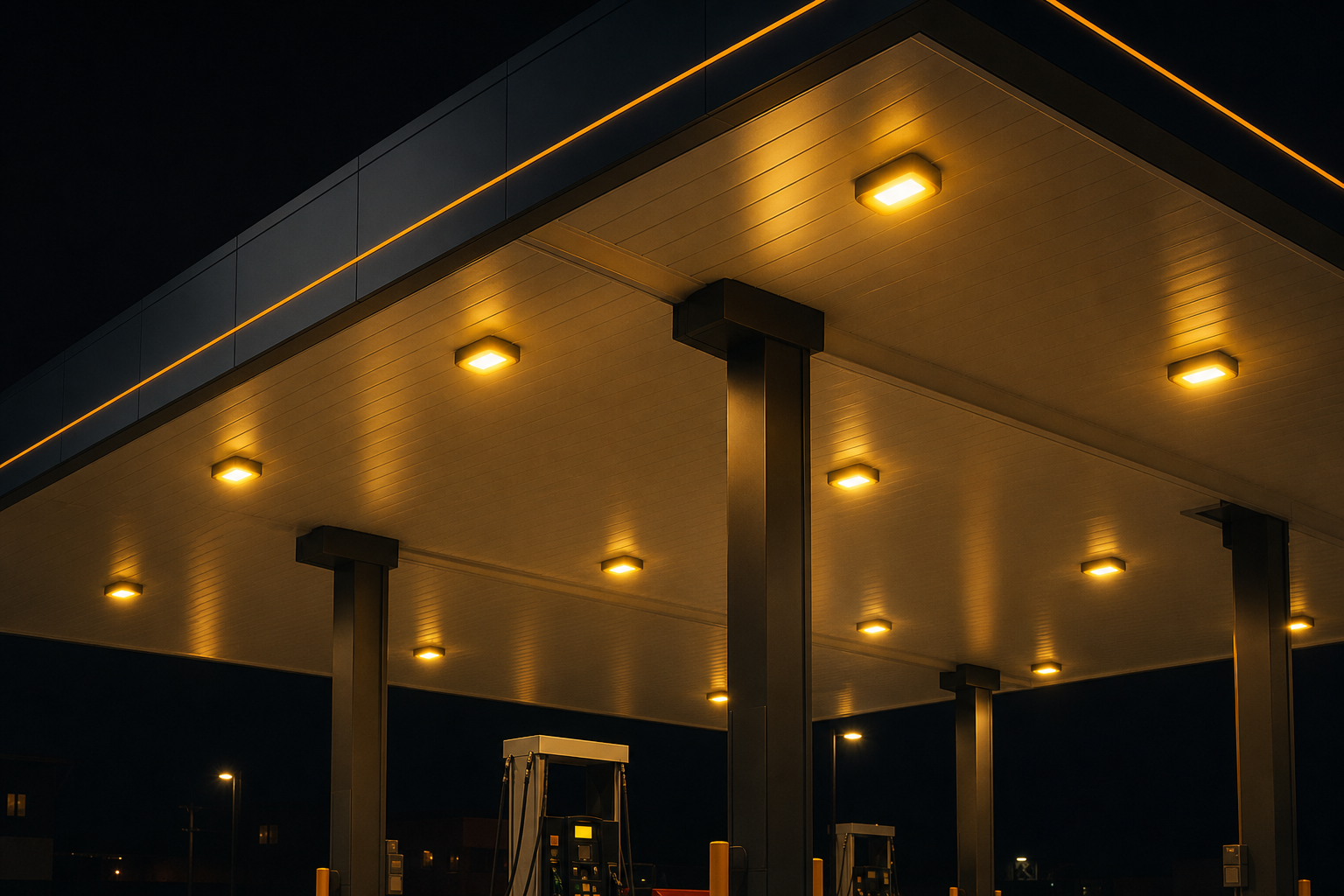
A LED canopy light is a recessed or surface-mounted fixture designed to be installed into the underside of a ceiling structure — the canopy over a petrol station forecourt being the defining case, followed by drive-through lanes, toll plazas, covered walkways and parking entrances. Its job is specific: put uniform, glare-controlled light onto the ground and onto people and pumps beneath a low ceiling, in an environment where fuel vapors, washing jets and 24-hour operation are all part of the specification.
Canopy lighting is a niche within the commercial outdoor range, but a commercially valuable one: fuel retail networks buy in fleet quantities, retrofit in waves, and specify hard. For distributors, it is a line where technical credibility — ratings, photometry, certification paperwork — wins the tender rather than the catalog photo.
Why canopy duty is its own engineering case
Three constraints separate canopy fixtures from ordinary downlights or floods. First, the environment: under a forecourt canopy the fixture faces fuel vapors and occasional washing from below, so housings and lenses are sealed to IP65 or better, materials are specified for flame retardancy, and in many markets the installation must comply with hazardous-area zoning rules around the pumps — the lighting contractor and local regulations define how far each fitting may sit from a dispenser, and fixtures themselves are commonly specified with appropriate fire classifications for ceiling integration.
Second, geometry: canopy ceilings sit low, often under four meters, and the light must travel a short distance to a wide target. Optics are designed for that — wide, controlled distributions that light the ground and the vertical of a pump island evenly without throwing glare across the approach road. A canopy light that reads well on a lux meter but blinds arriving drivers has failed its actual brief.
Third, duty cycle: forecourts run all night, every night. Energy and maintenance economics are calculated in 8,760-hour years, which is why LED conversion of fuel retail was one of the fastest retrofits in commercial lighting — halide-era canopies drew hundreds of watts per fitting and generated a permanent lamp-change scaffold problem, where a modern LED canopy fixture delivers comparable or better illuminance from a fraction of the power with years between interventions.
A fourth, quieter constraint is documentation culture. Forecourt operators are estate buyers: they retrofit tens or hundreds of sites against a written standard, so every claim in the quotation — flux, efficacy, ratings, spares policy — is checked against sample units at handover. Canopy fixtures that arrive with photometric files, wiring diagrams and a stated spare-parts list enter the approved-vendor shortlist; fixtures that arrive with a one-page leaflet do not, whatever their price. Distributors supplying this sector therefore sell paperwork alongside hardware, and the fixture brands that win fleet programs are the ones whose documentation survives the client's engineering review unedited.
Types and typical configurations
| Type | Mounting | Typical power class | Typical protection | Natural application |
|---|---|---|---|---|
| Recessed canopy fixture | Flush in canopy deck | 40-90 W | IP65-IP66 | Petrol forecourts, drive-through canopies |
| Surface-mounted canopy fixture | Fixed under deck | 40-100 W | IP65-IP66 | Retrofit where deck cutting is impractical |
| Low-bay style canopy unit | Surface / chain | 60-120 W | IP65 | Parking entrances, taller canopy structures |
| Compact under-canopy edge unit | Perimeter recess | 20-40 W | IP65 | Canopy edges, kiosks, covered walkways |
Category-typical ranges, illustrative only — real schedules follow each forecourt's photometric layout and local zoning rules.
The recessed flush type is the forecourt standard: a low-profile die-cast or composite housing with a polycarbonate or tempered-glass lens, sealed gasketing, and an external or internal driver tray accessible from below. Light output per fixture in the mainstream 40-90 W band typically falls between roughly 5,000 and 13,000 lumens at 120-140 lm/W efficiency, with CCT commonly specified at 4000K-5000K for forecourt visibility and color rendering chosen so fuel grades and signage read true. Fixture count and spacing always come from a photometric layout — the illustrative rule of thumb that a small four-island canopy lands near 8-12 fixtures is a starting point, not a design.
How to specify a canopy package
Forecourt lighting is designed to targets, not habit. The conventional design points a buyer will meet in tenders:
- Ground illuminance under the canopy. Commonly specified around 200-300 lux average beneath the canopy deck for the pump area, with uniformity minimums so no island sits in a dim patch; approach lanes and periphery carry lower targets.
- Vertical and semi-cylindrical illuminance. Faces and pump displays need light too; professional layouts check verticals, not just the ground plane.
- Glare discipline at the approach. Optics and cutoff chosen so drivers arriving at night are not lit head-on — this is a recurring complaint point and a real safety item.
- Ratings and materials. IP65+ sealed lens against wash-down; impact resistance where reachable; fire-classified construction for integration into the canopy deck per local rule.
- Controls. Photocell or timed switching as baseline; dimming to reduced overnight levels where curfew rules apply; increasingly DALI-addressable for networked fuel retail estates.
Where the canopy connects to the wider site — forecourt perimeter, shopfront, sign pylon — the canopy package is quoted alongside area floods and signage fixtures so the whole site ships as one coordinated schedule, as in the outdoor lighting range structure. Illuminance targets across these zones align with the conventional values in our lux level chart.
Sourcing canopy lights for export and fleet programs
- Certification per market. CE (LVD/EMC/RoHS) for the EU, UKCA for the UK, SASO/SABER for Saudi Arabia, SAA for Australia — via certified partner factories, verified per order with certificate numbers. North-American programs specify UL or ETL listings and DLC for utility rebates; those are arranged case-by-case per order, with lead time built into the project schedule.
- Photometric files as deliverables. IES/LDT files for the exact optic, so the fuel retailer's designer can produce the layout the tender requires. A canopy fixture quoted without photometry is quoted incomplete.
- Sealing and gasket quality. The under-canopy environment punishes cheap gaskets; sample wash-down and thermal cycling checks are standard in our inspection practice for this line.
- Driver access and serviceability. Fleet operators service fixtures in place; driver trays accessible from below, with common spare drivers stocked, decide total cost of ownership across an estate.
- Packing and lead time. Illustrative export reference: production 25-40 days for standard volumes; fixtures packed with lens protection for stacked container transport; FOB quotation within 24 hours of the item list.
Common mistakes in canopy lighting projects
- Designing only the ground plane. Uniform ground lux with dark pump faces still reads badly at the island. Check verticals in the layout.
- Copying an old count. Retrofitting a metal-halide fixture count with LED one-for-one usually over-lights; the LED layout starts from target lux, not legacy fittings.
- Ignoring local zoning around dispensers. Fixture placement near pumps is regulated; the lighting layout must respect the hazardous-area drawing, not the other way round.
- Under-rating sealing. Wash-down jets from below find any weak gasket within a season. IP65 is the entry point, not the achievement.
- No overnight dimming where required. Several markets now impose curfew or energy codes on forecourt lighting; fixtures without dimming input force non-compliance or full re-fit.
- Skipping glare review at the approach road. The cheapest fixture on the schedule can cause the most expensive complaint if it lights the windscreen of every arriving customer.
A canopy line rewards suppliers who think in tender documents: photometry, ratings, certifications and serviceability, evidenced per order. That is how we quote the category — forecourt drawings in, layout files and a certification map out, FOB price inside 24 hours.