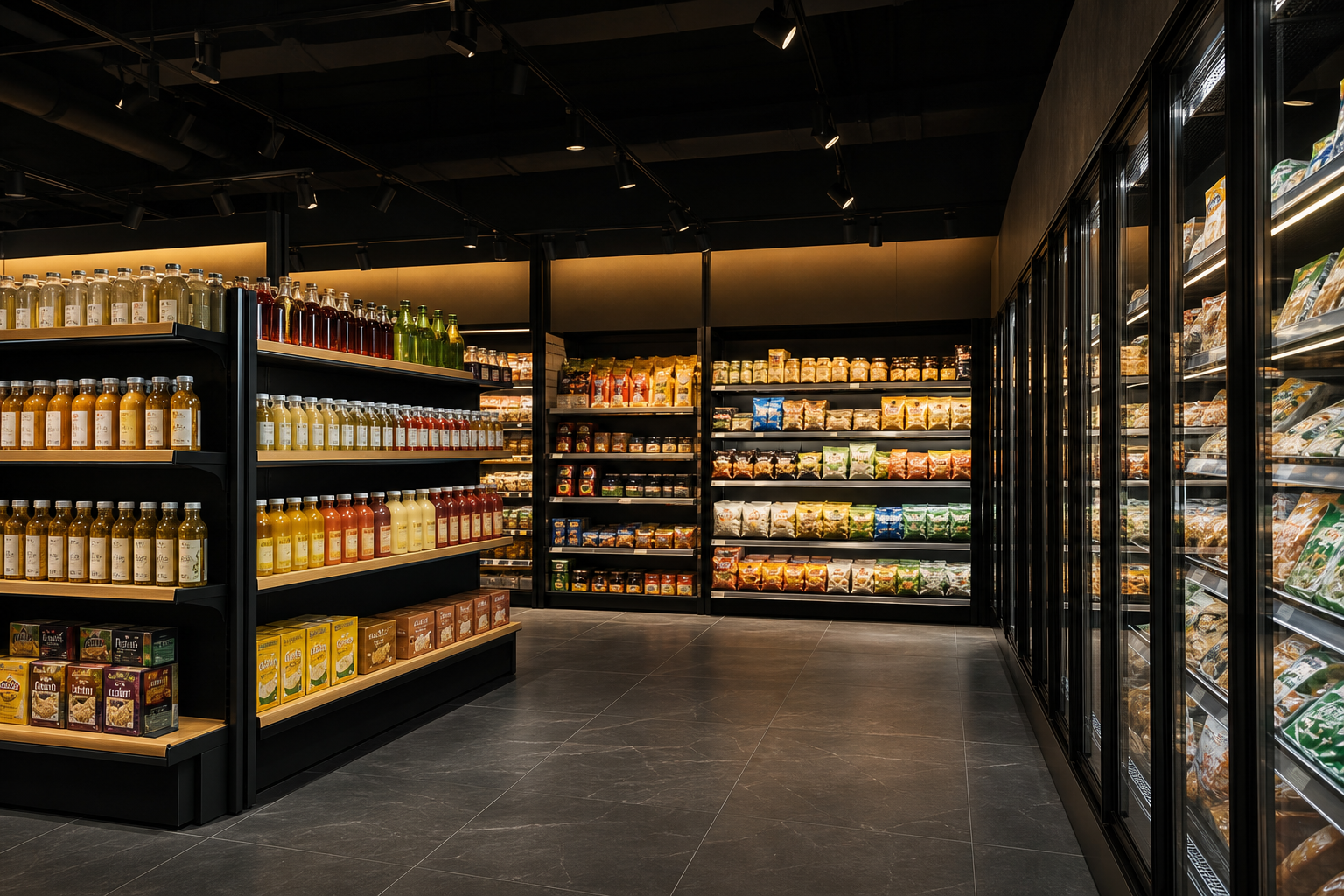
One store, three lighting problems: efficient aisles, flattering fresh food and fast checkouts. Zone parameters, spectra that sell produce, and controls that cut the bill.
2026-09-10 · 9 min read · Lighting guide
A supermarket is three businesses stacked in one hall. The grocery aisles are an efficiency problem — thousands of square meters that must be evenly navigable at the lowest possible watt-hours per basket. The fresh departments are a theater problem — produce, meat, fish and bakery sell on color, and light is the packaging. And the checkout is an ergonomic problem — fast scanning under light that neither fatigues cashiers nor flares their screens. Schemes that apply one fixture and one spectrum everywhere get the aisles right and lose money in produce; the zoning below is how grocery fit-outs avoid that.
Grocery ceilings are crowded — HVAC, sprinklers, case lighting, signage and the lighting have to share a 4-6 m slab — and the fixtures chosen must survive a store that runs 14-16 hours a day and washes down its floors. Design goals in the order operators rank them: even, glare-controlled general light for safe trolley movement and label reading; department-specific light that makes fresh food look abundant and appetizing; visual comfort at checkout where clerks work fixed-posture shifts; and a connected load the energy budget can carry — LED practice typically lands a grocery floor at roughly 6-10 W/m² for the general zones (illustrative; case-integrated lighting is accounted separately). Base constants: 4000 K and CRI 80 for general aisles, with the fresh departments as deliberate exceptions.
| Zone | Maintained lux (typical) | CCT | CRI | Notes |
|---|---|---|---|---|
| General grocery aisles | 300 lx, Uo ≥ 0.4-0.6 | 4000 K | 80 | UGR 22-25; linear battens or panels aligned to aisles |
| Seasonal / promotions | 300-500 lx with accents | 3000-4000 K | 80-90 | Track accents for flexibility; hierarchy sells the feature |
| Fresh produce | 500-750 lx | 3000-3500 K fresh-tuned | 90+ | High R9/Rf; greens and reds must read vivid, not neon |
| Butchery / meat | 500-750 lx | 3000 K accent, meat-enhancing spectra | 90+, high R9 | Warm accent over cases; honest color at the counter |
| Fish / seafood | 500-750 lx | 4000-5000 K accent | 90+ | Cooler white reads freshness; avoid yellow cast |
| Bakery / deli | 300-500 lx | 2700-3000 K | 90+ | Warm light sells bread crusts and pastry glaze |
| Frozen and dairy | 300-500 lx vertical on freezer doors | 4000 K | 80 | Verticals on glass doors; sealed fixtures in cold zones |
| Checkout | 500 lx task at belt | 4000 K | 80-90 | UGR 19-22; control glare on scanners and screens |
| Back store / cold rooms | 200-300 lx | 4000 K | 80 | IP65 tri-proof; occupancy sensors; cold-rated drivers |
Values are illustrative of grocery design practice; operator standards and local code govern the final figures.
The fresh-food rows deserve one caution: "meat-enhancing" and "produce-boosting" spectra are real products with measurable spectral shifts, and they work — but a lamp that renders the case brilliantly while distorting color once the product reaches the checkout invites distrust and, in some markets, regulatory attention. The professional line is CRI 90+ with high R9 and spectral tuning inside honest rendering limits, specified with the spectral power distribution on file, not a marketing name alone.
Where food is open, the fixture is part of the food-safety envelope. Over open cases and preparation counters, specify sealed IP65 bodies with cleanable surfaces — no exposed fins, no upward-facing crevices, glass or polycarbonate diffusers rated for wash-down practice — and lamps or modules that are shatter-protected where food is exposed below. In frozen aisles and cold rooms, the constraint becomes thermal: drivers must be rated for low ambient (down to -25 or -30 °C for freezer applications, typical), lumen output must be checked at cold temperature, and condensation cycles argue again for sealed housings. Above enclosed freezer doors, remember the physics: shoppers read vertical faces of glass doors, so the vertical illuminance row in the table matters more than the floor number under the case.
The arithmetic below shows the shape of a grocery lighting budget after LED practice. Take a 1,800 m² sales floor, 14 hours a day, 365 days a year (illustrative figures for orientation only):
| Line | Fluorescent-era scheme (illustrative) | LED scheme, no controls | LED + daylight & presence |
|---|---|---|---|
| Connected general lighting load | ~12 W/m² | ~7 W/m² | ~7 W/m² |
| Annual burn (sales floor) | 5,100 h | 5,100 h | ~4,100 h effective |
| Annual energy, general zones | ~110,000 kWh | ~64,000 kWh | ~51,000 kWh |
| Back-of-house, cold rooms | Full output, always on | Full output, always on | Sensed, ~60% cut (typical) |
Illustrative arithmetic for orientation; the real run comes from project photometry, store hours and local tariffs.
One more line item belongs in the comparison: case-integrated lighting. Open multi-deck cases increasingly carry their own linear LEDs under the shelf noses, and the ceiling scheme then drops its case-row output accordingly. Buyers should require the two systems to be calculated together — a ceiling layout run as if the cases were dark will overshoot, and the overshoot lands exactly on the energy line the LED project was sold on.
Grocery hours are long and predictable, which makes controls unusually effective. The standard package: daylight harvesting at perimeter and skylit zones — grocery boxes with skylights routinely dim 30-50% of general lighting for most daylight hours (illustrative); occupancy control in back-of-house, cold rooms and corridors, where rooms sit empty most of the day; scheduled scene steps for opening cleaning and closing; and emergency and exit circuits on their own governed scope. DALI-2 grouping pays twice in grocery: energy reporting per department for the P&L, and effortless re-zoning when the seasonal aisle moves. One integration note — refrigeration racks and lighting controls share ceiling space and switchboards; agreeing bus topology before installation is a ten-minute conversation that saves a re-pull.
Chain operators increasingly buy lighting controls twice: once for the savings, and once for the data. A DALI-2 backbone that groups fixtures by department reports energy per zone, flags failed drivers as maintenance tickets instead of dark shelves discovered by staff, and feeds the store-level sustainability reporting that grocery retailers now publish. The specification consequence is modest but real: require the control system to provide per-group energy metering or runtime logs, and name the export format in the contract. The same backbone then carries the store's seasonal life — the holiday aisle re-zoning, the garden shop taking over seasonal space — in configuration rather than rewiring, which is the quiet difference between a control layer that stays useful for a decade and one that gets abandoned at the first refit.
Grocery buys on documentation as much as on price. The checklist: photometric files (IES/LDT) per fixture and optic; a layout calculation on the real store plan with case locations, reporting aisle uniformity and checkout task planes; spectral data for fresh-food lamps (SPD files, CRI R9, Rf/Rg where tunable spectra are quoted); IP65 and cold-rating certificates for food and freezer zones; flicker data (PstLM ≤ 1.0, SVM ≤ 0.4 as EU-facing references); and DALI-2 or equivalent control compatibility in writing. Certification by destination (CE, UKCA, SASO and others) is issued via certified partner factories with verifiable documentation. For multi-store rollouts, lock a fixture schedule per format and hold binning consistency across orders — a chain where one store's produce glows differently from the next's has a brand problem, not a lighting problem.
Illustrative commercial terms: samples of 1-5 pcs ship in 7-14 days; trial orders 100-200 pcs per SKU; bulk production 25-40 days after deposit; pricing quoted per project or per store format. The retail and showroom lighting page covers the sales-floor families, the commercial lighting line indexes panels, battens and track, and the industrial line carries tri-proof and cold-storage fixtures for back-of-house. Send a store plan with the case layout; the department-by-department schedule is the first reply.
Recommended illuminance by application, including retail and food zones.
Neutral and cool white, and where each belongs in a grocery box.
Sealed fixtures for cold rooms, wet zones and wash-down areas.
CE, UKCA, SASO and DLC by destination market — what your order requires.
Aisle, fresh-food and checkout parameters with spectra documentation — first response within 24 hours.