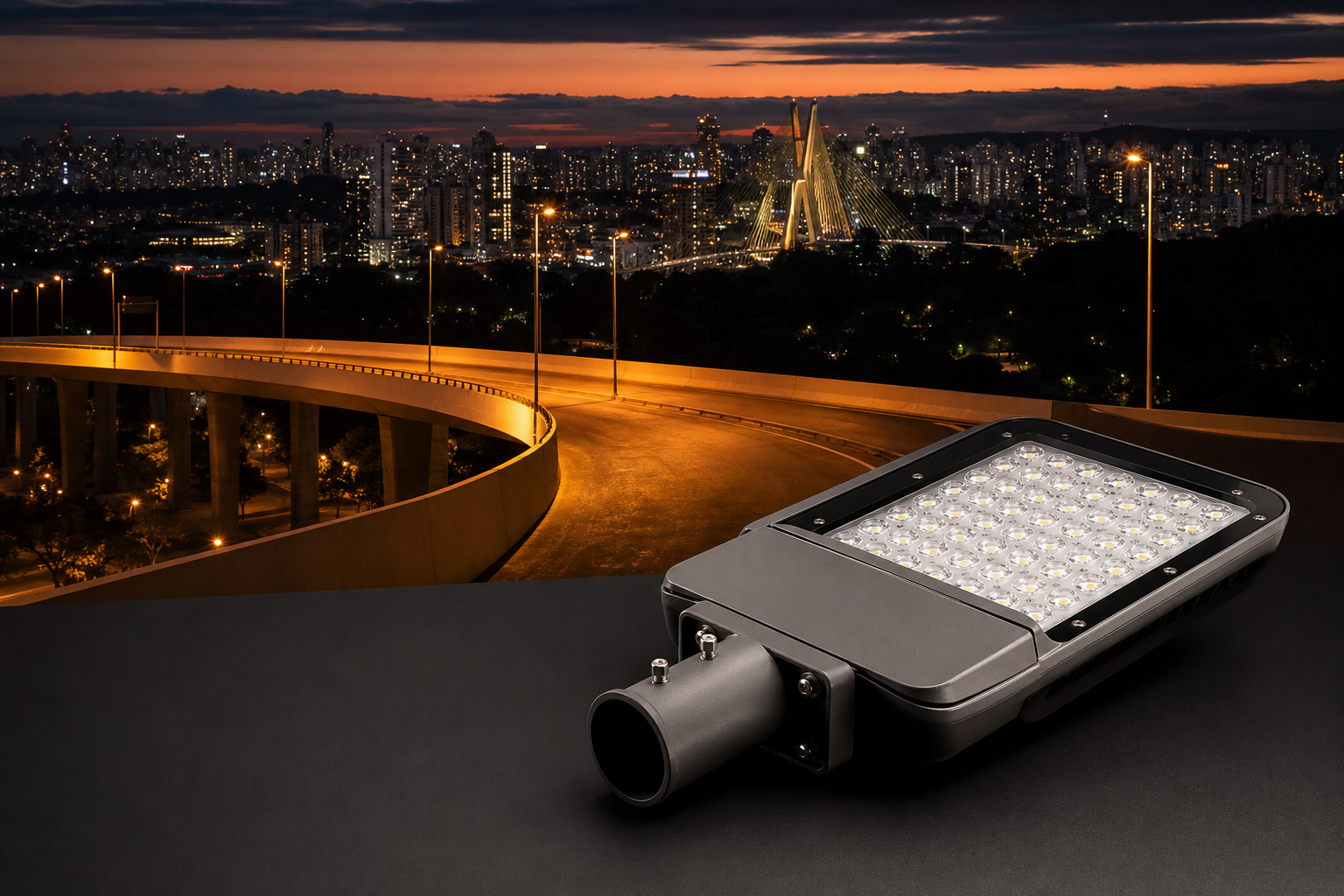
Brazil's conformity system is real, enforced and slower than most exporters expect. Which products it bites, how the certification path runs, and the traps that turn a good order into a port problem.
2026-09-10 · 8 min read · Compliance guide
INMETRO — the National Institute of Metrology, Quality and Technology — is Brazil's regulator for measurement and product conformity. Its force comes from the compulsory conformity-assessment lists: product families that may not be commercially placed in Brazil without certification under the INMETRO system. LED lighting sits squarely in that machinery: general-service LED lamps have been subject to compulsory certification for years, and categories of LED luminaires — public and street lighting prominent among them — fall under their own conformity requirements, with the scope defined in INMETRO ordinances and updated over time. The buyer's first task is therefore classification: confirm for the exact product category whether certification is compulsory, and under which ordinance and standard set — scope has grown model by model, and an assumption imported from another market is the most common surprise in Brazilian lighting programs.
A positioning note per this site's practice: AURELUX serves Latin American programs with INMETRO arrangements made through certified partner factories on a case-by-case basis — no INMETRO certificates are claimed as standing holdings, and none should be inferred. Where a Brazilian order requires INMETRO, the certificate path below is built into the project plan, not discovered at the port.
INMETRO conformity for lighting runs through accredited third parties and always includes a factory dimension — this is a system certification of production, not a one-off lab stamp:
| Step | What happens | Notes for planning |
|---|---|---|
| 1 | Classify the product; confirm the applicable ordinance and ABNT NBR standards | Standards generally track the IEC family in ABNT NBR form (for example, the ABNT NBR IEC 60598 series for luminaire safety) plus Brazilian-specific requirements |
| 2 | Contract an OCP — a product certification body accredited by INMETRO | The OCP runs the process end to end; choosing one with lighting experience shortens everything |
| 3 | Testing at accredited laboratories | Sample-based testing against the NBR standards; plan lead time in weeks, not days (illustrative) |
| 4 | Factory quality-system audit by the OCP | Production consistency, test equipment and traceability at the factory — the step China-based programs must prepare for |
| 5 | Certification decision and registration | Certificate of conformity issued and registered in the INMETRO system |
| 6 | Apply the INMETRO identification marking | Mandatory marking on product and packaging per the certification rules |
| 7 | Maintain the certificate | Periodic surveillance audits and testing; certificates expire and renew on a schedule |
Timelines, validity periods and fees vary by category and OCP; treat the table as the shape of the path and price the current reality per program.
The local actor problem. Brazilian conformity and import machinery presumes in-country responsibility: the importer of record interacts with customs, and certification programs run far smoother with a Brazilian counterpart managing the OCP relationship. Exporters without local presence solve this through the buyer's structure or qualified local partners — arranged before the contract, not after the first detention. The time problem. Certification is a months-scale project the first time (testing, audit, registration), which collides with buyers who expect EU-style document speed; the fix is sequencing — run the INMETRO track in parallel with commercial negotiation, never in series after the PO. The wireless overlap. Any smart or connected fixture with Wi-Fi or Bluetooth also needs ANATEL homologation, Brazil's separate telecoms regime — two projects, two timelines, and smart lighting is exactly where exporters forget. The cost stack. Beyond certification fees, Brazil's import tax structure (federal and state layers) transforms landed cost math; a competitive FOB price can lose the project at the DDP comparison, so model landed cost with the buyer early. Language and labeling. Portuguese-language instructions and labeling are part of consumer-law compliance, independent of INMETRO marking.
Brazil is demanding, not closed — the exporters who succeed there treat conformity as part of the product. The same discipline drives how this site maps every destination on our certifications page; the solar and street categories where Brazilian demand concentrates are profiled in our outdoor and solar and street and municipal lines.
The OCP relationship deserves management, not just contracting. Practical experience across Brazilian lighting programs points to a few habits that separate smooth certifications from stalled ones. Submit production-representative samples and say so in the covering documents — certification covers the product as manufactured, and a cherry-picked sample creates a gap the factory audit will find anyway. Prepare the factory for the audit as a project: test equipment with valid calibration records, traceable component intake (the driver and LED bins matter here as everywhere), in-line inspection records, and someone on site who can answer in the auditor's working language. Agree the family logic in writing with the OCP — which models one certificate covers, on which test basis — because the family definition determines both cost and how future model variations inherit conformity. And maintain a single named coordinator on the supplier side; OCP processes involve the lab, the auditor and the certification decision-maker, and programs drift when three people answer separately.
After the certificate comes the part programs forget: conformity is a living status. Surveillance audits and periodic testing arrive on the certificate's schedule; production changes — a new driver source, a new housing supplier — can trigger re-evaluation; and the INMETRO identification marking must track the certificate's actual scope on every production run and carton. Exporters who treat the certificate as annual renewal paperwork get surprised by audit findings; those who fold it into their standard QC calendar treat Brazilian orders as routine. Budget the maintenance into the program's cost model from the start — the renewal cycle is predictable, and a lapse discovered at customs costs an order of magnitude more than the audit that would have prevented it.
Another platform-registered conformity regime — Saudi's step-by-step path.
The TCO comparison behind Brazil's street-lighting demand.
Why EU evidence does not transfer — and what each regime actually certifies.
Destination-by-destination compliance mapping for every program.
INMETRO and ANATEL routing arranged through certified partner factories, case by case — send the product list for a feasibility plan within 24 hours.