The single lighting regulation quietly decides which lamps may enter the EU and which documents must exist before they do. What it covers, what it demands, and who registers what.
2026-09-10 · 8 min read · Compliance guide
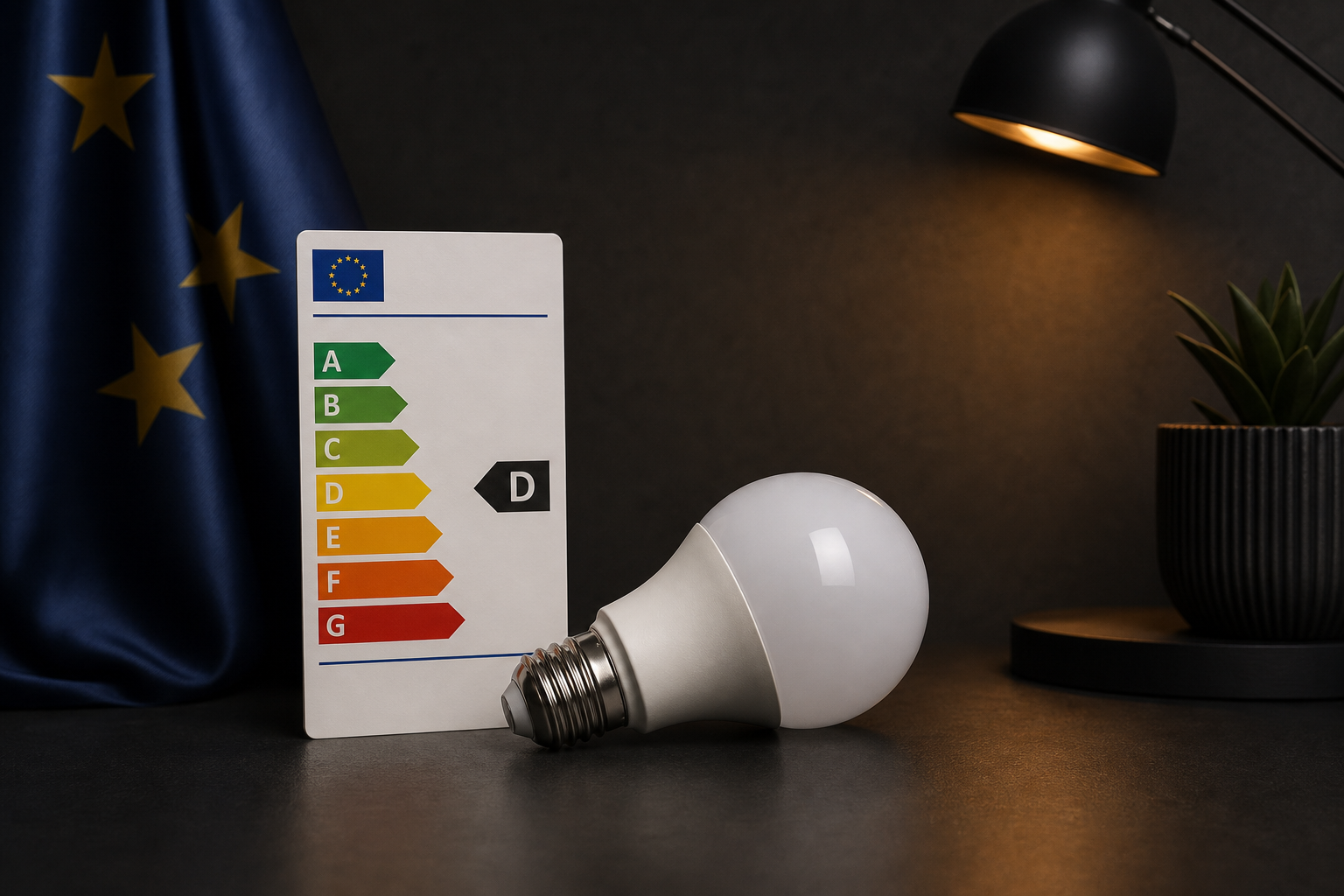
Regulation (EU) 2019/2020 — the "single lighting regulation" or SLR, the ecodesign chapter of what buyers casually call ErP — applies to light sources and separate control gears placed on the EU market, in force since 1 September 2021, replacing the older ecodesign rules for lamps. It is one of two regimes that govern EU lighting paperwork. The second is the energy labelling regime (the rescaled A-G label under Regulation (EU) 2019/2021) and its EPREL registration database. The distinction trips up suppliers constantly: ecodesign (2019/2020) sets the performance floor a product must meet; labelling (2019/2021 plus EPREL) sets the information product that must exist before the product is offered for sale. A light source can pass every performance test and still be illegal on the EU market if its EPREL registration is missing.
Scope notes that save arguments: luminaires as housings are not light sources and generally do not carry their own EPREL registrations, but the replaceable light sources and separate control gears inside them do fall under the regulation's requirements when placed on the market. AURELUX labels ErP/EPREL status per product on EU-bound programs — conformity here is organized through certified partner factories, verified per order.
The regulation's Annex II sets the performance floor. In buyer's terms, the tests that matter most:
| Requirement | What it means | Who it eliminates |
|---|---|---|
| Maximum on-mode power | Allowed power is a function of luminous flux and source type (the Annex II formula) — an efficacy floor expressed in the regulation's own math | Low-efficacy LED product; yesterday's halogen-look performance |
| Color rendering | CRI/Ra minimum of 80 for most sources, 90 for certain uses | Bargain LEDs that hit lumens but fail color |
| Flicker (PstLM) | PstLM ≤ 1.0 — the short-term flicker indicator | Cheap drivers with visible flicker on camera and in perception |
| Stroboscopic effect (SVM) | SVM ≤ 0.4 applying from September 2024 | Drivers that pass flicker but fail the stroboscopic metric |
| Lifetime & survival | Minimum survival factor and lumen maintenance over defined test hours per source type | Unmaintained commodity LEDs with optimistic datasheets |
| Displacement factor | Power-factor-type requirements scaled by flux and power | Non-corrected drivers in mid-range product |
| Standby power | Standby and networked standby capped (0.5 W band) | Smart-adjacent products that idle high |
Figures above summarize the regulation's structure for buyer use; exact constants live in the Annex tables and are updated by amending regulations — verify against the current text at design time.
On the phase-out side, the SLR plus related acts ended most mercury-containing fluorescent exemptions on a dated schedule — the practical reality is that fluorescent replacements for EU channels are a closing door, and LED retrofit lines are the only durable answer. Verify current exemption dates rather than relying on older summaries.
Every light source within labelling scope must be registered in EPREL — the European Product Registry for Energy Labelling — before it is placed on the EU market, with the label and product information sheet generated from the registration. Registration is the duty of the supplier: the EU-based manufacturer, the importer who places a non-EU product on the market, or the authorised representative acting for one. This is the practical answer to the question every non-EU supplier faces: a Chinese factory cannot simply self-register; the registration duty lands on its EU importer or appointed responsible entity — which is why serious export programs define that role contractually before the first shipment. The registration carries the model's measured data: flux, on-mode power, efficacy, CRI, CCT, flicker and stroboscopic metrics, lifetime claims — the same numbers the test reports hold, which is one more reason the test program should be designed once, correctly, for both regimes.
The safety-and-substances half of EU compliance (LVD, EMC, RoHS) is covered separately in our CE guide; the destination map sits on the certifications page. For product-side implications — which commercial lines this pressure reaches first — see the commercial lighting catalog.
The efficient way through the SLR is to design the laboratory program for both regimes at the same time, because the same measurements feed the ecodesign file, the EPREL registration and the energy label. The working sequence: classify the model (light source type, directional or not, control gear or integrated); run the Annex II metric set — on-mode power against the formula, CRI, CCT, PstLM, SVM, displacement factor, standby, survival and lumen maintenance at the defined checkpoints; and capture the outputs in the exact fields EPREL expects, so registration becomes data entry rather than a second test campaign. Labs that work regularly on EU lighting export recognize this combined package and quote it as one scope; labs that quote "ErP testing" and "EPREL testing" separately are inviting you to pay twice for overlapping measurements.
Two boundary notes complete the program design. Product families: like CE, ecodesign tolerates well-argued family testing — one driver family, a bounded flux range, identical construction — and the family definition should come from the lab in writing, because the registration structure in EPREL must mirror it model by model. Revisions: any change to the LED package, driver or optical stack is a new technical reality and potentially a new registration; the change-notification clause from your supplier agreement is what makes that visible before shipment rather than after a market-surveillance letter. For buyers assembling the full EU pack, this test program sits alongside the safety-and-substances suite described in our CE guide — different regulation, largely the same laboratory, and a coherent single briefing to both saves weeks.
Who feels the regulation most? Three groups. Importer-distributors of lamps and retrofit sources carry the sharpest duties — they are the "supplier" placing product on the market, and the registration, label and information-sheet obligations land on their desk with their name on them. Project buyers specifying complete luminaires feel it indirectly but constantly, because the replaceable sources and drivers inside their schedules must each clear the same bars, and a tender line as simple as "sources to be SLR-compliant with EPREL registration" quietly disqualifies a third of the quotations. And exporting factories feel it as a documentation capability: the plants that serve the EU in volume maintain Annex II test data as a product asset, refreshed on revision, which is why the EU-ready answer to "can you provide flicker data?" arrives in hours rather than weeks. AURELUX's per-product ErP/EPREL status labeling exists precisely to make that capability visible at the schedule level, before commitments are made.
The LVD, EMC and RoHS half of EU compliance — the other document pack.
How the two flicker metrics are measured and what good drivers look like.
The buildings directive pushing controls into EU tenders — the next compliance wave.
Destination-by-destination compliance mapping for every program.
Annex II testing, EPREL registration routing and per-product status labeling via certified partner factories — send the model list for a compliance plan within 24 hours.